Monday, May 30, 2011

Probability: Sample Space

Sample space - the set of all possible outcomes of an experiment.


Tree Diagrams & Ordered Pairs are often used to list sample space.


Tree Diagram Example: Sketch the sample space for tossing 3 coins.


Ordered Pairs Example: Sample Space for rolling a pair of 6 sided dice.

The probability that a specific event will occur can be described as:

Example: The probability of drawing a black ball out of a bag of 13 coloured balls is 3/13. Find the probability of not drawing a black ball.

  • Independent Events - 2 events occur so that neither one affects the probability of the other.

ex. Tossing a coin and rolling a die.

  • Dependent Events - when 2 events occur that do affect the probability of the other.

ex. Drawing two cards from a deck without replacement.


Wednesday, May 11, 2011

Pascal's Triangle [Magic 11's]

If a row is made into a single number by using each element as a digit of the number (carrying over when an element itself has more than one digit), the number is equal to 11 to the nth power or when n is the number of the row the multi-digit number was taken from.

Tuesday, May 10, 2011

COMBINATIONS

Permutations - Selecting and ordering (two actions)
Combunations - Selecting (one action)

Formula for combitations:

n!/r!(n-r)!
Ex.
10C5

1st step: Just like Permutation find n and r and arrange according to the formula

n=10
r=5

10!/5!(10-5)!

2nd step: Substract (n-r)!
10!/5!5!

3rd step: Evaluate

10*9*8*7*6*5!/5!5! -> cancel one 5! in numerator and denominator

4th step : simplify
10*9*8*7*6/5! --> 30240/120 = {252}

252 is the final answer


Ex. 2

A class that consists of 24 boys and 15 girls. Class committee must consists 10 students. How many ways can this be done if, there are to be 7 boys and 4 girls in this class committee

Calculate:
Formula: Boys * Girls

Boys

24C7
24!/7!(24-7)!
24!/7!17!
24*23*22*21*20*19*18*17/7!17!--->24*23*22*21*20*19*18/7!
1,744,364,160/7!
=364,104

Girls
15C4
15!/4!(15-4)!
15!/4!11!
15*14*13*12*11!/4!11!--->15*14*13*12/4!
32760/4!
=1,365

364,104*1,365 = {497,001,960}

Monday, May 2, 2011

Factorial Notation

Today we learned about factorial notation. The symbol n! (read as n factorial) means to multiply all of the positive integers from n all the way down to one (1).

FORMULA USED: n!= n(n-1)(n-2)...(3)(2)(1), where n is an element of the positive integers.

Example 4:

5!= ----->n=5 so when you plug in to the formula you get:

5(5-1)(5-2)(5-3)(5-4)
(5)(4)(3)(2)(1)
=120

We can remember these factorials:
  • 0!= 1
  • 1!= 1
  • 2!= 2
  • 3!= 6
  • 4!= 24
  • 5!= 120
  • 6!= 720
  • 7!= 5040
  • 8!= 40320
  • 9!= 362880
  • 10!= 3628800
We can also simplify factorial equations:

Example 5:

a) 5!/4! ----->we can expand the 5! to (5)(4!)
(5)(4!)/4! ----->and the (4!)'s are able to cancel out each other leaving the (5)
=5

e) (s-2)!/(s+1)! ----->we can expand the (s+1)! into: (s+1)(s+0)(s-1)(s-2)!
(s-2)!/(s+1)(s+0)(s-1)(s-2)! -----> since there are two (s-2)!'s in both the numerator and the denominator, they can cancel out leaving us with the answer
=1/(s+1)(s+0)(s-1)


Hall of Famer for April

Please cast your votes for the Hall of Famer of April.
The winner will receive 5 bonus points...

Friday, April 22, 2011

Hey Mr.P Help!!

Solve:
48 ÷ 2(9 + 3)

So I randomly seen this equation on a forum, and It seems everyone is debating,between the answers. The answers people get is either 2 or 288.

I personally think it is 2.

Above I have broken it down to what people may think it looks like. Now the way I see it is the first one.

So what is the real answer? Because when I enter 48÷2(9+3) on my calculator I get 2. But on another calculator I get 288.

Wednesday, April 13, 2011

Soliving Exponential Equation

On Tuesday we learned about Solving Exponential Equation:

Exponential rules :
am an = am+n
am/an = a m-n
(am)n = amn
1/am = a -m
a0 =1


Steps :

1. Make the bases on each side equal
2. Cancel same bases
3. Solve the remaining exponent equation


Examples:

3-3k = 9
3-3k = 32
-3k = 2
k = - 2/3

5 3-2x X 5 3x-3 = 25
5 3-2x X 5 3x-3 = 5 2
3-2x + 3x-3 = 2
x =2

27 2n = 81 n-3
27 2n = 81 n-3
3 3(2n) = 3 4 ( n-3)
6n = 4n -12
2n = -12
n= -6

Tuesday, April 12, 2011

Exponential Functions

On Monday we learned about Exponential Functions.


The function f(x) = abx were a and b are real numbers such that a is not equal to zero,

b is greater than zero and b is not equal to one, is an exponential function where :

a is constant

b is a base

x is an exponent

Basic Curve : f(x) = ax where a > 0

y = a -x will reflect the basic curve in the y- axis.

y = -a x will reflect the basic curve in the x- axis.

y = a x-h+k will shift the basic curve right by ‘h’ and up by ‘k‘

**Read ‘h’ values as opposite, ‘k’ values as is.**


An exponential function is said to be an increasing function when "a" is greater than 1.

An exponential function is said to be a decreasing function when "a" is greater than 0 and less than 1.


Note: pastedGraphic.pdf


Example #1:

Sketch the following exponential functions on the same Cartesian plane.


Monday, April 11, 2011

March Hall of Famer

And the winners are:
1. Katherine 29 points - 5 bonus points
2. Jennifer 18 points - 4 bonus points
3. Joyce 16 points - 3 bonus points
4. JR 12 points - 2 bonus points
5. Jilliane 12 points - 2 bonus points

Congratulations.

Tuesday, April 5, 2011

Hall of Fame

Please cast your vote (under comments) for the Hall of Famer of the March. Winner will receive 5 bonus points, 2nd place 4 bonus points, 3rd place 3 bonus points, 4th place 2 bonus points and 5th place 1 bonus point.

Monday, April 4, 2011

Double Angle Trigonometric Identities

The Double Angle Identities:

sin(2θ)= sin(θ+θ)= sinθcosθ + cosθsinθ= 2sinθcosθ

cos(2θ)= cos(θ+θ)= cosθcosθ-sinθsinθ= cos 2θ-sin 2θ

cos(2θ)= cos 2θ-sin 2θ= 1-sin 2θ 2 cos 2θ

tan(2θ)= tan(θ+θ)= tanθ +tanθ/1- tanθ+tanθ= 2tan/1-tan2θ

**NOTE**

csc2θ= 1/sin2θ

sec2θ=1/cos2θ

cot2θ=1/tan2θ

Example: verify

sin3 x = -4sin3 x+3 sin x

LHS= sin 3x
=sin(2x+ x)
=sin 2x cos x + cos 2x sin x
=(2sin x cos x)cos x+ ( cos 2 x-sin 2 x)sin x
=2 sin x cos 2 x + cos 2 x sin x - sin 3x
=2sin x(1-sin 2 x)+(1-sin 2 x)sin x - sin 3x
=2sin x- 2 sin3 x+ sin x -sin3 x- sin 3x
LHS=-4sin3 x + 3 sin x = RHS

Wednesday, March 23, 2011

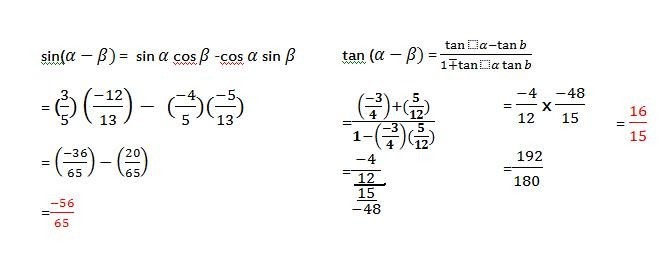
sum and difference identities (part 1)


HOMEWORK: Exercise 16, Question 1-18, Omit 5b, 6, 9a
                          Sum and Difference Identities worksheet.